The South Coast of Puerto Rico: Puerto Real, Gilligan’s Island, Salinas & Palmas del Mar (18° 4.746″ N, 65° 47.743″ W) – by Theresa

South coast of Puerto Rico

South coast of Puerto Rico

We have been on the move quite a bit over the past 10 days. Part of that has been driven by our desire to take advantage of favorable weather windows and part of it is that we would like to be in the British Virgin Islands by mid March so that we can meet friends and family that are planning on visiting while we are in the BVI.

We had a wonderful time at the Cap Cana Marina in Punta Cana, Dominican Republic but at the risk of sounding like the boys, our newest favorite spot will likely be replaced at the top of the list by our next stop.

Cruising past Mona Island

Cruising past Mona Island

The day we left Cap Cana was a big one for us as it was the day we would transit the infamous Mona Passage. The 80+ mile trip from Punta Cana, Dominican Republic to Puerto Real, Puerto Rico was at times challenging with large seas and little comfort to be found for the first few hours. Once we had moved sufficiently south and east of the Hour Glass shoals, the ride became much more civilized and we settled in for our transit. We were treated to natures wonder time and again, first by flying fish by the hundreds all around Pilot’s Discretion, then dolphin, and ulitmately by a massive hump back whale breaching less than a hundred yards off the Pilots’ Discretion starboard beam.

By the end of the passage, we had seen things in one day that many people will not see in a lifetime. We successfully navigated our boat across the Mona Passage, left one country for another and arrived feeling very much like we had grown both as a family and a functioning crew.

This slideshow requires JavaScript.

Our first port of call in Puerto Rico was a charming little fishing village by the name of Puerto Real. The marina is an excellent facility in a well protected harbor. The town has a very quaint, small town feel with excellent re-provisioning stores nearby. The weekend we arrived was the Marina Pescadería Sailing Rally and the associated festivities at the marina were an added enjoyable bonus for all. Everyone we met were very helpful and understanding of our B+ attempts to communicate in Spanish.
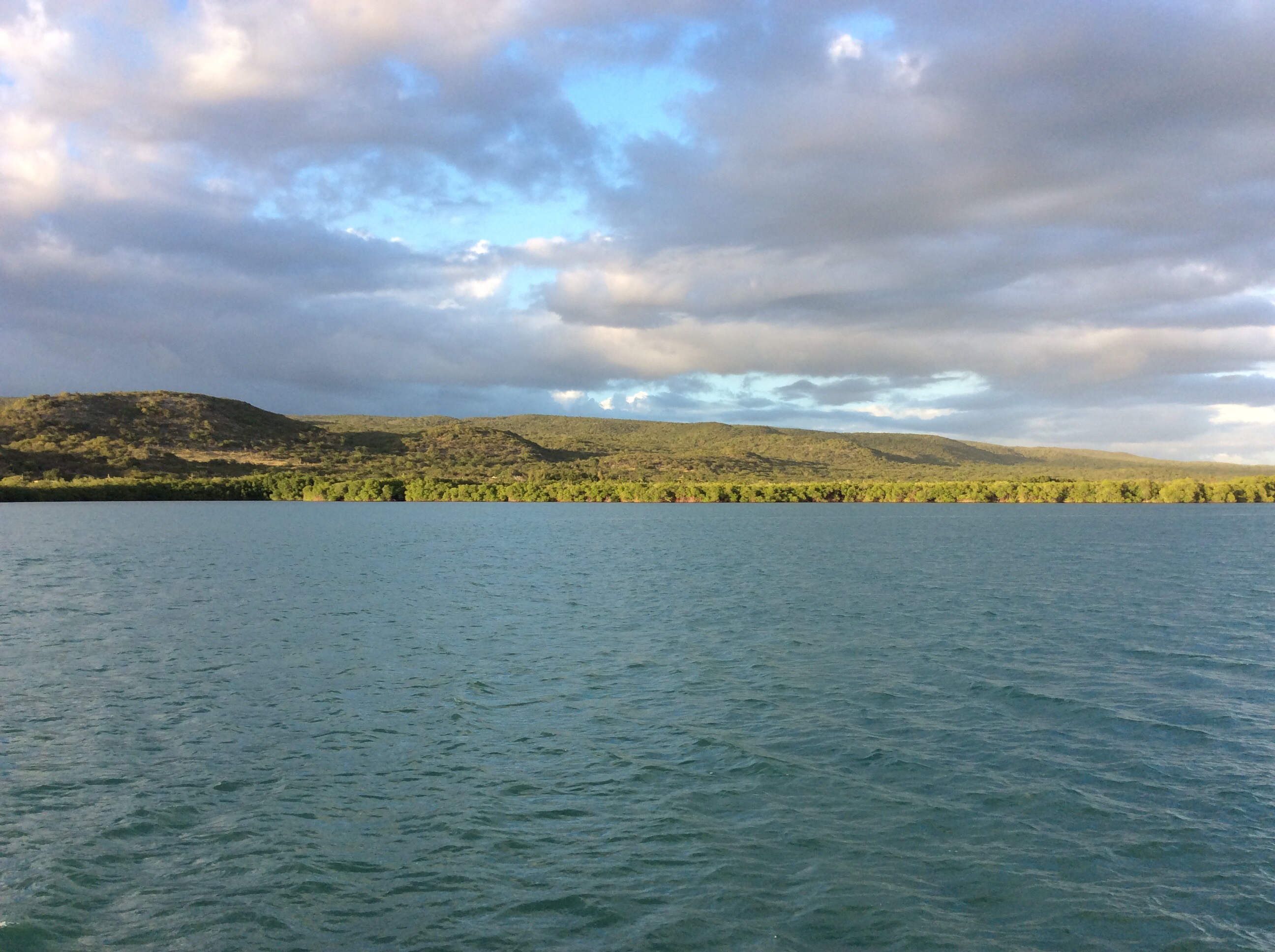
Anchored off Cayos de Cana Gorda (a.k.a. Gilligan's Island), Puerto Rico

Anchored off Cayos de Cana Gorda (a.k.a. Gilligan’s Island), Puerto Rico

After enjoying a couple of days in Puerto Real, we moved south and east around Cabo Rojo to Cayos de Cana Gorda, also know by the locals as Gilligans Island (a not so subltle reference to the islands resemblence to the island in the Bob Denver comedy sitcom of the same name). We anchored off the island and spent a quiet evening in company with three sailboats.

At sunrise we were underway again, this time headed for Salinas, Puerto Rico. Salinas is another one of those spots the cruisers love. There were probably 50 boats in the harbor when we arrived.

Wind farm, Salinas, Puerto Rico

Wind farm, Salinas, Puerto Rico

It was rewarding to listen to the boys discussing the wind farms we saw along the coast  excited that they had just recently read and learned about them in homeschool.

We would have liked to stay and explore a bit but we are feeling the need to keep the odometer rolling to be in position for our soon to arrive guests. Hence, another sunrise and another day underway finds us now tucked into the marina at Palmas del Mar, on the east coast of Puerto Rico, just south of Fajardo.

It is here that we celebrated another birthday aboard the Pilot’s Discretion when Patton turned 13!

Patton's 13th birthday

Patton’s 13th birthday

The next leg of our journey  will take us to the Spanish Virgin Islands. It really does at times feel like this must be a dream. We have been blessed to have an opportunity to experience this trip. Stay tuned, we love sharing our journey with all of you.
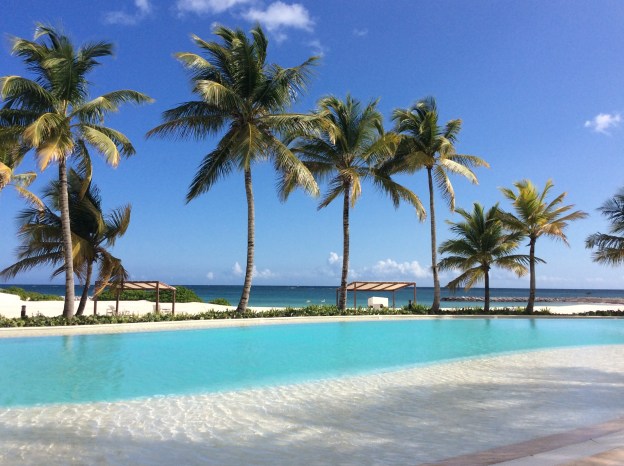
 

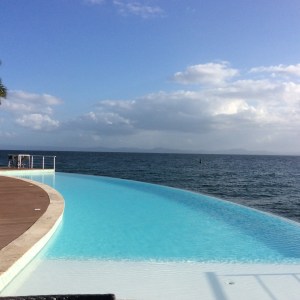
Pool at Cap Cana Marina, DR

The North Coast of the Dominican Republic, Samana and Punta Cana – by Randy

Pilot's Discretion DR North Coast track

Pilot’s Discretion DR North Coast track

As I write this we are tucked in a slip at the Cap Cana Marina in Punta Cana, Dominican Republic. We have travelled the approximately 200 nautical miles from Ocean World, Puerto Plata to position ourselves at the southeastern edge of the Dominican Republic so that we will be in a favorable location to initiate our crossing to Puerto Rico via the Mona Passage next week. The journey across the north coast of the Dominican Republic, including stops at Marina Puerto Bahia de Samana and Punta Cana, has been spectacular.

Northern coastline of the Dominican Republic

Northern coastline of the Dominican Republic

We left Ocean World before dawn on February 4. As the sun rose, we were underway, enjoying our morning coffee as the light revealed a truly amazing coastline off our starboard beam. The Dominican mountains come to the waters edge, terminating in sheer cliffs that the Atlantic breakers continuously pummel in a spectacular display of natures might. It was quite awe inspiring being able to watch from the comfort of the Pilots’ Discretion as we cruised a couple of miles offshore.

Once around Cabo Samana, we entered the calm waters of Samana Bay which is a very large, protected bay on the east coast of the D.R. We pulled into Marina Puerto Bahia de Samana for fuel and a couple nights rest. We have been very surprised by the quality of the marine facilities that we have found in a country that in many areas lacks the basic necessities of life. The marina infrastructure is second to none and in many cases, far nicer than most marinas that you would find in Florida or other boating centers in the United States.

While in Samana we took the opportunity to hire a couple of very hard working “boat boys” to wash the Pilots’ Discretion and polish her stainless steel. We also had a diver clean the hull and running gear in preparation for our crossing of the Mona Passage.

On February 6th, we were once again underway at dawn, this time we were leaving in company with six sailboats who were all going in the same general direction as us. The sight of the sailboats off our beam and stern as the sun rose was really beautiful and reminded us why we love our time at sea so much.

It wasn’t long after departure that it became evident that we would not be running in company with our new sailing friends for long. We were operating at our slowest idle speed and it was clear that we were still pulling away from the gaggle of sailboats. As we watched the sailboats disappear off our stern, we set up for a 10 knot cruise and made the turn southeast to round Cabo Engano and make our way to Punta Cana.

Whale breaching the surface just off our port side

Whale breaching the surface just off our port side

About an hour into our day we began to see what this area is famous for; dozens of migrating humpback whales were visable all around us. Some we could only see the moisture rising as they were breathing through their blowholes off in the distance but on a few occasions, a whale would breach the surface and put on a show within a few hundred yards of the Pilots’ Discretion. In the words of the boys, “that was awesome!”

The videos of the whales do not come close to capturing the magnificence of the spectacle that they provided us; it truly was one of those “you had to be there” moments.

We are going to spend a few days here in Cap Cana as we attend to some routine maintenance items before heading off for Puerto Rico. The good news for  us is that Frank Castillo, the Cap Cana Marina Dockmaster has gone way out of his way to help us in any way that he can as we prepare for the next leg of our journey. We will post next from Puerto Rico.


Puerto Plata, Dominican Republic – by Theresa

We arrived in the Dominican Republic (DR) on the eve of “Natalicio Juan Pablo Duarte,” a DR national holiday celebrating the birthday of the country’s founder. As such, we were treated to local fireworks displays, parades and festivities.

Dominican Republic countryside

Dominican Republic countryside

In addition to enjoying the local cultural celebrations, we have all been putting our Rosetta Stone lessons into practice. Earlier this week, Ronan impressed the marina concierge when he communicated, in Spanish, our need for a rental car for the following day. When the car arrived, we headed off to explore the island, first to Puerto Plato, a medium sized metropolitan area, and then to Luperón, which is more rural. We opted not to pull the boat into port in Luperón, however, we used the rental car opportunity to visually survey the port as it is a well known hurricane hole should the need for such protection present itself.

Cable Car, Loma Isabel de Torres, Dominican Reupblic

Cable Car, Loma Isabel de Torres, Dominican Reupblic

We next headed to Isabel de Torres which is famous for a cable car that takes you to the summit of a 760 meter mountain. In the National Park, atop the mountain, is a 16 meter high Christ the Redeemer statue, similar to the one found in Rio de Janeiro, Brazil. The National Park also has botanical gardens, hiking trails and caves that we all enjoyed exploring.

Christ the Redeemer, Loma Isabel de Torres, Dominican Republic

Christ the Redeemer, Loma Isabel de Torres, Dominican Republic

As is typical in the Dominican Republic, the heat of the day pushes the warm, moist marine layer of air up the mountain slopes where it cools and condenses, creating clouds and rain that enveloped the mountain top. We rode the cable car down the mountainside, through the clouds, and returned to the boat just before the afternoon thundershowers.

The next leg(s) of our journey will have us traversing the north coast of the Dominican Republic eastward towards Puerto Rico. Since there is significant northern exposure, we are continuing to wait for an appropriate weather window that will allow us to continue our journey.


Pilot's Discretion Route, Bahamas to The Domincan Republic

Southern Bahamas, Turks & Caicos, and the Dominican Republic – by Randy

ACKLINS ISLANDS , BAHAMAS

Since we last posted, we have covered some significant territory. We left Clarence Town, Long Island on January 20 to continue our voyage south. The route we elected to follow took us through a fairly remote section of the Bahamas so we really did not expect to see many other boats along the way. Our first day out we stopped to anchor in Atwood Harbor, Acklins Island. The harbor is fairly small with a beautiful white sand beach, protected from weather in all but a northerly swell. Since we had been underway for 10 hours without seeing another vessel either visually or on the radar, you can imagine our surprise when two sailboats showed up to anchor just after our arrival. The good news is the harbor had plenty of room and we all settled in for a good nights rest.

MAYAGUANA, BAHAMAS

The next day, we were underway at first light, our destination, Abraham’s Bay, Mayaguana. Mayaguana is one of the southernmost Bahamian islands known primarily for the role it played during the heyday of the United States manned space missions. At one point the US had an extensive missile tracking complex on the island. That complex has long since been shut down and the only reminders of it’s past existence are an 11,000 ft runway, a dilapidated and unusable cargo ship dock and a decaying series of fuel tanks. On our trip in we spent most of the day motoring in company with the 177′ Megayacht “Bacchus”. Bacchus continued on non stop to the Turks and Caicos but given that we had left our professional crew behind in Safety Harbor, we elected to stop for a good nights rest before pressing on to our next country.

Our arrival into Abraham’s Bay was uneventful and we spent the night in our 5 mile long harbor completely alone.

PROVIDENCIALES, TURKS & CAICOS

After one night in Mayaguana we were off to the second foreign country on our itinerary. As we approached the Turks and Caicos we found a great deal more traffic in the area than we had seen in the southern Bahamas. The radar and AIS were both lighting up with constant targets as we approached the Caicos bank from the north.

This slideshow requires JavaScript.


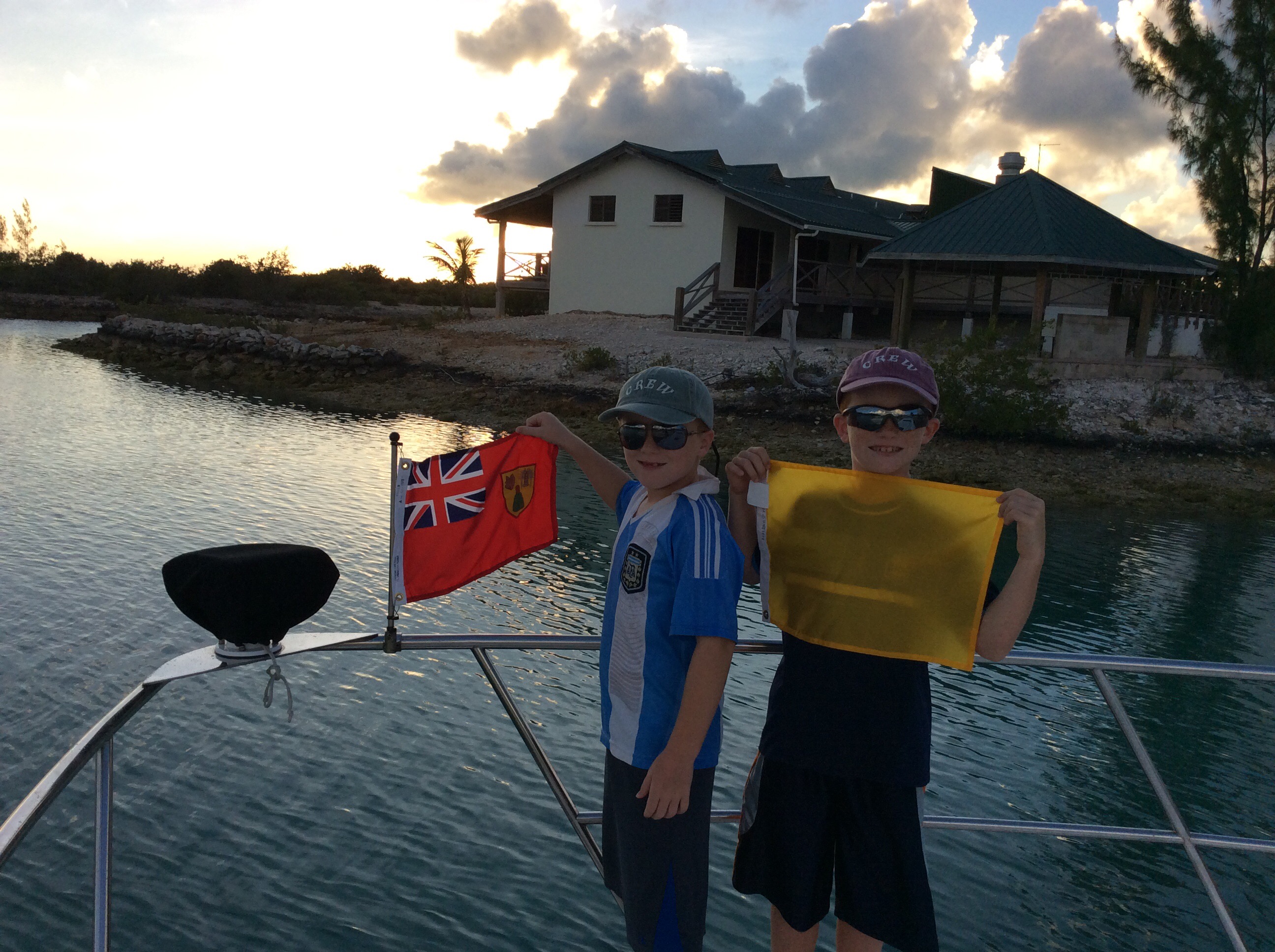
Upon entering Turks & Caicos waters, Ryan hoisted the quarantine flag. We pulled into the South Side Marina in Providenciales, Turks and Caicos at about 4pm. After arriving, I proceeded to meet with the customs and immigration officials to handle the clearing in procedures.

R&R on flag duty hoisting the Turks & Caicos courtesy flag

R&R on flag duty hoisting the Turks & Caicos courtesy flag

All of the officials were extremely professional and pleasant and although at times it can feel like things are in slow motion in the islands, we were cleared in and the Turks and Caicos courtesy flag was flying from our jack staff in time for dinner.

Given the distances we had travelled the previous couple of days and the length of the trip from the Turks and Caicos to the Dominican Republic,  we elected to spend a couple of days resting up in Providenciales.

PUERTO PLATA, DOMINICAN REPUBLIC

On Saturday, January 24th, we got underway for what would be our third country in one week.The trip from Providenciales to our next stop, Puerto Plata, Dominican Republic took us across an area known as the Caicos bank. As the name implies, we had to run about 50 miles across an area where the average depth was 8′ or less and there are numerous coral heads scattered throughout the area that reduce that depth even more. As we exited the Caicos bank into the North Atlantic the depths go from the aforementioned 8′ to more than 6000′ in the distance of less than a mile. That kind of sudden change to the shape and depth of the sea creates an extensive area of strong currents and square waves that provided us the roughest ride we have experienced to date on this trip. Although we had seen larger seas when we crossed from the Abacos to Eleuthera, the waves had a much longer period, making them much easier to traverse. For a distance of about 20 miles we were constantly burying the bow of the Pilot’s Discretion into the oncoming waves. Once sufficiently clear of the Caicos Bank, the ride in the Atlantic became much more pleasant and we settled in for the next 90 miles of our journey. Approaching the Dominican Republic, it is clear that both the topography and the climate are far different from the Bahamas.

The mountains of Hispaniola become visible both on radar and to the naked eye about 40 miles out. The mountains in conjunction with the abundant moisture from the Atlantic create towering cumulous clouds that usually result in afternoon thunderstorms.

This slideshow requires JavaScript.

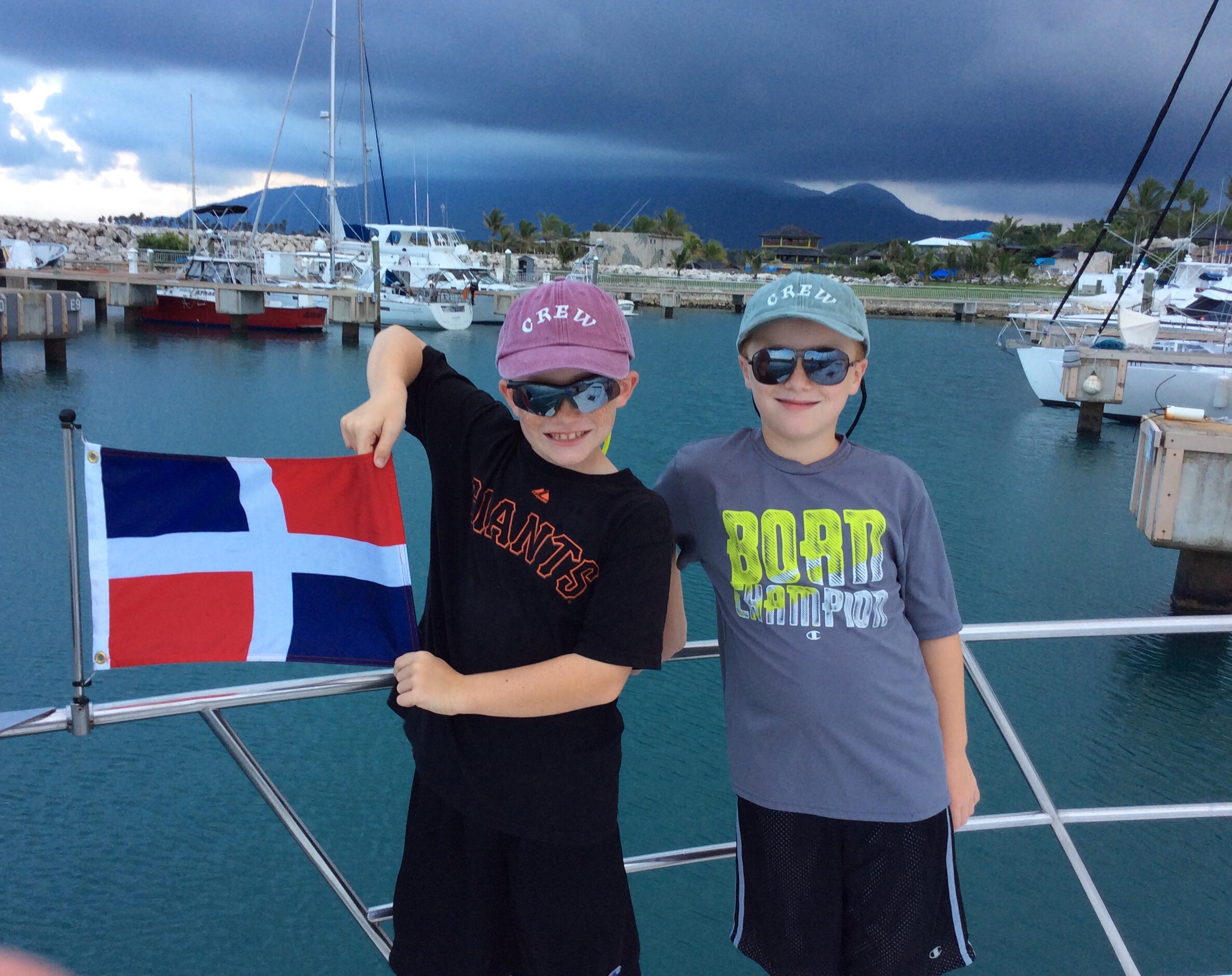
R&R on flag duty hoisting the Domincan Republic flag

R&R on flag duty hoisting the Domincan Republic flag

After clearing customs and immigration at Ocean World Marina in Puerta Plata, Domincan Republic, the boys manned their flag duty station once again to fly the Domincan Republic courtesy flag. The current weather forecasts indicate that we will have a few days to explore Puerto Plata before we have a sufficient weather window to embark on the next leg of our journey. We intend to use that time to explore the Dominican countryside and culture. We will report what we find in our next post.


Clarence Town, Long Island Bahamas (Latitude 23°06.123” N Longitude 074°57.604” W) – by Randy

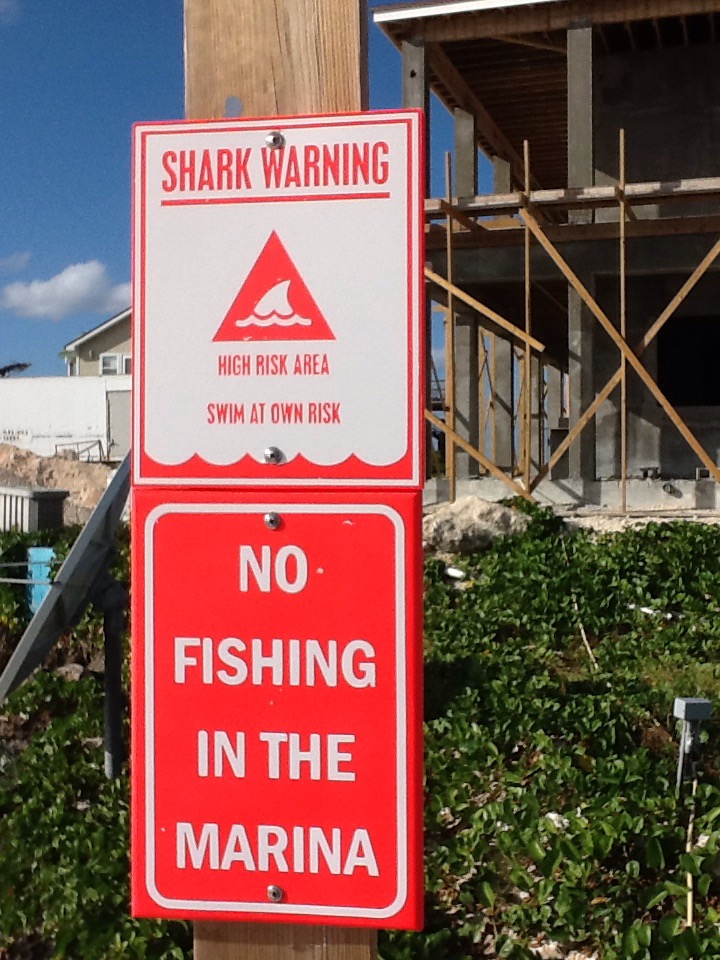
"Shark Warning" sign at Flying Fish Marina, Long Island, Bahamas

“Shark Warning” sign at Flying Fish Marina, Long Island, Bahamas

We are currently tucked into a slip at the Flying Fish Marina in Clarence Town, Long Island. When we departed Georgetown, Exumas, we were officially heading out of the Exumas as well as leaving the main cruising grounds favored by boaters when they envision a trip to the Bahamas.

On our trip south from George Town, we had another geographical milestone when we crossed the Tropic of Cancer (the latitude demarcation denoting the furthest north the sun travels in the summertime) at 23°30.000 N. We are officially now in “The Tropics.”

From here on, we will be in an area that is primarily a route to and from the Caribbean. That said, Clarence Town is justifiably a destination worth visiting even if you were not transiting to points south.

One of the two churches built by Father Jerome, Clarence Town, Long Island, Bahamas

One of the two churches built by Father Jerome, Clarence Town, Long Island, Bahamas

The town is famous for two skyline churches designed by Father Jerome. Father Jerome was a priest, trained as an architect at the end of the eighteen hundreds. He arrived in the Bahamas in 1908 with the mission of building church structures stout enough to withstand the force of the many hurricanes that have hit the islands. As such, all of his churches are made out of stone and are quite imposing and impressive.

Church, Clarence Town, Long Island, Bahamas

Church, Clarence Town, Long Island, Bahamas


The locals take great pride in their quaint island community and we found them all welcoming and always willing to lend a hand to a stranger.

The marina here is a first rate facility that caters to large sport fishing boats that ply the waters between here and the Turks and Caicos. Each day we have been here, we have seen several 75′ plus Hatteras and Viking Sport Fishing boats come in and take on 1500- 2000 gallons of fuel each.

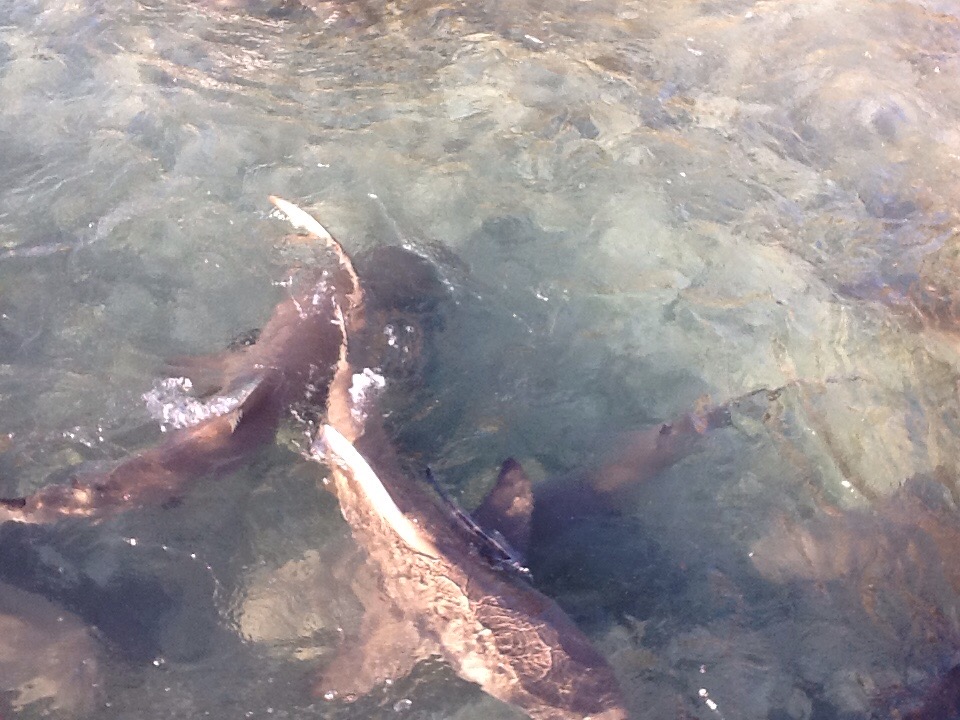
Bull Sharks at Flying Fish Marina, Long Island, Bahamas

Bull Sharks at Flying Fish Marina, Long Island, Bahamas

While here, the crews from the boats have been cleaning their catch at the dock and that has provided us an opportunity to once again be entertained by the shark population indigenous to these waters. The sharks that we saw in the Exumas were a mix of primarily nurse sharks with a few black tip and lemon sharks, but here it is a different story. We are seeing almost exclusively bull sharks and they have put on quite a show for us as you can see in the video below.

They are so aggressive that when we accidentally dropped the end of our hose into the water a bunch of bull sharks hit it and shredded it instantly! When the next weather window presents itself we will continue our journey south and will post again from the Turks and Caicos.